Lily Sundelin and Karsten Sundelin’s Marriage
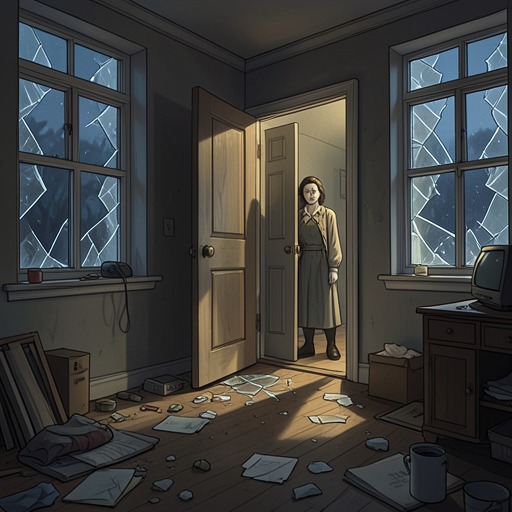
The CallerLily Sundelin and Karsten Sundelin’s Marriage is transformed by the attack on their daughter, Margrete: the effortless intimacy of their early family life gives way to fear, protective withdrawal, and a widening emotional separation. The novel traces that change through domestic scenes, where familiar gestures and rooms first express their closeness and later make its loss visible.
Early Intimacy and Family Life
At the marriage’s outset, Lily’s sense of happiness is bound up with Karsten, their home, and their infant daughter. Three photographs on the kitchen wall arrange that family into a small, complete world: Lily beneath a maple tree, Karsten on the porch, and the two of them together on the sofa with Margrete between them. Seeing the pictures, Lily thinks of the child as a miracle, a feeling she finds reflected in the sunlight and the curtains moving through the house. The family’s happiness is not abstract; it inhabits ordinary rooms and routines.
Their intimacy appears just as plainly in their playfulness. While Lily is occupied with dinner, Karsten teases her, puts his arms around her waist, and leads her from the kitchen toward the lounge. She protests weakly, and he mimics her voice; their exchange is easy enough to turn work and flirtation into one scene. Later, after they eat, Karsten’s approving look matters to Lily. She admires his clear green eyes, his dark hair, and his lean, strong build, imagining that neither time nor age can undo what they have together. These details establish the confidence that the marriage will endure before the attack makes that confidence seem fragile.
The Attack Enters the Marriage
After Margrete is attacked, the couple’s shared home becomes the setting for a crisis neither can simply leave behind. Karsten’s response hardens into rage. When Lily smooths the baby blanket, he speaks of tearing the assailant’s arms and legs off and compares him to an insect. Lily does not answer. Her attention to the blanket and Karsten’s violent threats occupy the same moment, but point in opposite directions: she tries to make the child’s surroundings orderly, while he imagines bodily punishment.
The new anger frightens Lily even as she is moved by Karsten’s impulse to protect the family. She notices that his voice has become coarse, that he is constantly on guard, and that he seems ready to meet danger before it arrives. His protectiveness gives her comfort, but it is also a change she wants him to release so they can resume their lives. That mixed response makes the strain more complicated than a simple division between one frightened spouse and one indifferent spouse: both are affected, but his defensiveness does not restore their former security.
A Shared House, Separate Fears
Several weeks after the attack, Karsten wakes at half past three and discovers that Lily and Margrete are not in their bed. He finds them in the lounge, where Lily sits with the sleeping child in her lap. The cot has been moved into the bedroom, yet Lily has settled elsewhere with Margrete; the arrangement registers how the attack has altered the family’s sense of safety. In the dim room, Karsten watches them and understands that fear has taken hold of Lily and stolen the peace they once assumed was theirs. He says they cannot go on living this way.
His effort to reassure her does not bridge the distance. He tells her that the assailant will eventually be caught and justice served, and suggests that life will return to normal. Lily responds with a hurt look and remains in her corner of the sofa, blanket over her knees and Margrete on her lap. Karsten experiences her withdrawal as a place he cannot reach: whatever he says or does, he feels that she has pushed him away. Even his reminder that some parents lose their children permanently does not bring them together. The scene makes their conflict one of incompatible needs as well as shared grief: he reaches for reassurance through words about justice, while she clings to the immediate shelter of the child and the sofa.
Resentment and Failed Approaches
As time passes, Karsten’s distress spreads into his view of the marriage. He thinks that the incident has opened cracks in the foundations of his life, and admits to himself that he is no longer in love with Lily and has begun to dislike her femininity, fear, and vulnerability. Those thoughts bring despair because he also wonders whether he is the one who has failed his family. The attack has not only injured their trust in the outside world; it has made each spouse’s way of suffering difficult for the other to bear.
Karsten tries to discharge his agitation through physical work. He repairs loose boards in the garden fence, hammers nails, and chops wood until chips fly, while Lily watches from inside and remains absorbed in caring for Margrete. He also begins stopping for drinks after work and sometimes comes home late and drunk by taxi. Meanwhile, when a nurse comments that Margrete has gained considerable weight, Lily rises so abruptly that her chair falls and pounds the table. Her forceful defense of the child shows how concentrated her attention has become on Margrete, even as Karsten interprets her lack of visible irritation at his late returns as another sign of distance.
At night, with Margrete between them in bed, Karsten sometimes reaches out to touch Lily’s shoulder or hair as he once did. She answers with an involuntary shudder. The gesture is small, but its reversal is stark: touch, once part of their familiar intimacy, now irritates or unsettles her. Karsten recognizes that Lily has established new rules for their life together and struggles to understand them. The marriage’s deterioration is thus shown not only in his explicit doubts but in the body’s refusal of an old habit.
Wider Fallout and Significance
The damage also changes how Karsten relates to the surrounding community. At a petrol station in Bjerkås, he meets Bjørn Schillinger, who believes that someone is endangering people’s lives and says he may lose everything. The two find immediate common ground as bitter men craving revenge. Their alliance does not repair the marriage; instead, it shows Karsten’s anger finding company beyond the home, where suspicion and retaliation offer a bond of their own.
The marriage’s arc rests on a contrast between its beginnings and its aftermath. Early scenes place Lily and Karsten side by side in a household they regard as secure, with Margrete at its center. After the attack, the same family life is reorganized around vigilance, care, and unspoken fear. Lily’s protection of Margrete and Karsten’s rage both arise in response to the violation, but neither restores their former closeness. The relationship is presented as progressively fractured and emotionally estranged; the evidence here establishes that rupture without supplying a final reconciliation or a definitive account of the marriage’s legal status.